The Majlis has functioned as the UAE’s primary social infrastructure for centuries. What began as a designated reception area in Bedouin tents evolved into dedicated rooms in permanent structures, serving as venues for conflict resolution, business negotiation, and family gathering. The space operated under strict protocols: gender-separated areas, hierarchical seating arrangements that reflected tribal status, and an aesthetic vocabulary drawn from Islamic geometric principles and regional craft traditions.
Between 2020 and 2025, this architectural typology underwent substantial transformation. The changes reflect broader shifts in how Emirati families inhabit their homes, but they also reveal something more specific: a design community attempting to reconcile the functional requirements of contemporary life with cultural practices that remain meaningful.

From Palace Aesthetic to Desert Modernism
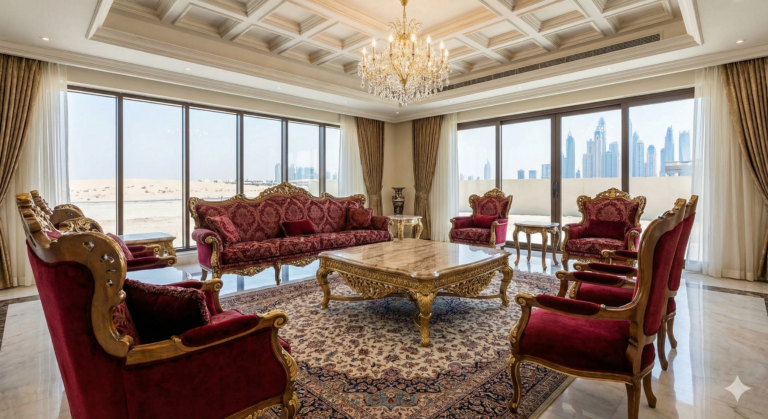
The dominant interior vocabulary for luxury Majlis spaces until recently drew heavily from European decorative traditions. Rococo furniture, velvet upholstery in jewel tones, ornate gold leaf detailing, and crystal chandeliers were standard specifications. This approach, sometimes called the “Palace Aesthetic,” emphasized visual opulence as a marker of hospitality and status.
Current projects show a different material palette. Designers working on high-end residential commissions in Dubai and Abu Dhabi now specify materials that reference the UAE’s physical landscape rather than imported decorative traditions. Sand-toned limestone, travertine with minimal veining, walnut or oak timber in natural finishes, and bronze or brass in matte rather than polished treatments have become standard specifications. Textile selections favor raw linen, handwoven cotton, and undyed wool rather than silk or damask.
This shift involves more than aesthetic preference. The new palette performs differently in the UAE’s climate and lighting conditions. Matte surfaces reduce glare from intense sunlight. Natural stone stays cooler than synthetic materials. Undyed textiles require less chemical processing and show wear differently than dyed fabrics, aging rather than deteriorating.
Color specifications have narrowed considerably. Greige (grey-beige hybrids), terracotta, warm grey, and variations of sand dominate current projects. This limited range creates visual cohesion across open-plan layouts while providing enough variation to define different functional zones within a single space.

The Mashrabiya’s Technical Evolution
The Mashrabiya, a projecting oriel window enclosed with carved wood lattice, served multiple functions in traditional Islamic architecture. It provided women a way to observe street activity while remaining unseen, created cross-ventilation in buildings without mechanical cooling, and filtered harsh sunlight into diffused interior illumination.
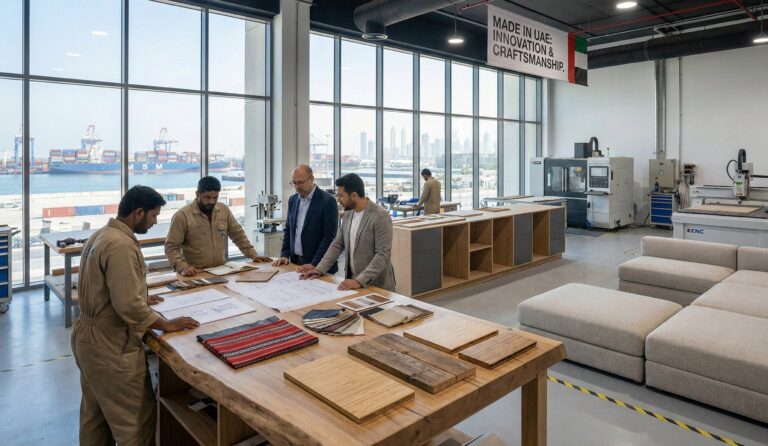
In contemporary UAE projects, the Mashrabiya has been extracted from its original structural context and reimagined as a spatial divider. Designers now specify laser-cut metal screens, CNC-milled wood panels, or even 3D-printed polymer lattices that reference traditional geometric patterns while serving new functions.
These screens appear most frequently in open-plan villas where families want to maintain visual connection between spaces while creating degrees of privacy. A Mashrabiya panel might separate a formal Majlis from an adjacent family room, allowing parents to monitor children while hosting guests. The lattice maintains airflow and light transmission while creating a threshold that guests understand they should not cross without invitation.
Recent projects have incorporated parametric design software to generate patterns that respond to site-specific conditions. Architects input data about the sun’s path, prevailing wind direction, and desired light levels, then use algorithms to generate lattice geometries that optimize these variables. The result looks like traditional Islamic geometric patterns but performs with precision impossible in historical examples.
Some projects take this further, incorporating motorized panels that adjust their porosity based on time of day or occupancy sensors. A screen might open to 60% transparency during family time, then close to 20% when guests arrive, all without anyone touching a control panel.
Reimagining Seating Layouts
Traditional Majlis seating followed strict spatial logic. Built-in benches or low sofas lined the perimeter walls, with cushions and bolsters providing back support. The center of the room remained empty except for coffee service. This arrangement served multiple purposes: it maximized capacity for large gatherings, created clear sightlines for conversation, and reinforced social hierarchy through seat positioning relative to the host.
Current layouts introduce what designers call “conversation cores.” Rather than peripheral seating, furniture gets grouped in clusters within the room’s center. An L-shaped sectional might anchor one zone, with a pair of lounge chairs creating a secondary conversation area nearby. These arrangements sacrifice some capacity but enable different types of interaction: small group discussion, one-on-one conversation, or casual family gathering.
The shift reflects changing use patterns. Families report using Majlis spaces more frequently for daily activities rather than reserving them exclusively for formal reception. The room needs to accommodate children doing homework, parents reviewing documents, and spontaneous gatherings alongside traditional hosting functions.

Modular furniture systems have become standard specifications because they allow quick reconfiguration. A family hosting a large event can push modules together to create continuous perimeter seating, then return to intimate clusters for daily use. Some custom pieces incorporate hidden casters or lightweight construction specifically to enable this flexibility.
Designers working on these projects face a calibration challenge: how much capacity reduction will families accept in exchange for improved everyday functionality? Most settle on layouts that accommodate roughly 70% of the guest count the old peripheral system could handle, judging that families rarely host at maximum capacity but use the space daily.
Invisible Infrastructure
The technical systems required for a contemporary Majlis present design challenges that didn’t exist in traditional spaces. Air conditioning, lighting controls, audio systems, and charging infrastructure all need to be integrated without visible disruption.
Cooling represents the most significant constraint. Dubai’s summer temperatures make mechanical climate control necessary, but families object to visible vents or ceiling-mounted units. Designers respond by specifying underfloor air distribution systems that eliminate ceiling diffusers, or by incorporating ventilation into architectural elements like cove details or wall panels. Some projects use displacement ventilation that introduces cool air at floor level, allowing it to rise naturally as it warms, which requires no visible ductwork.
Lighting design has moved away from single statement chandeliers toward layered systems that combine multiple sources. Cove lighting hidden in ceiling details provides ambient illumination. Recessed spots highlight specific areas or objects. Floor lamps or table lamps create pools of light for reading or conversation. Control systems allow users to activate different combinations for various activities: bright overall light for large gatherings, dim ambient light for intimate conversation, or task lighting for work activities.
Acoustic treatment addresses a problem inherent in traditional Majlis design: hard surfaces (marble floors, plaster walls, minimal soft furnishings) create significant echo in large rooms. Contemporary projects incorporate acoustic panels behind decorative fabric wall treatments, specify rugs sized to cover at least 60% of floor area, and use upholstered furniture with sufficient mass to absorb sound. The goal is to reduce reverberation time to levels that allow comfortable conversation without raising voices, even when the room holds 20 or 30 people.
Technology integration happens at multiple scales. Charging ports get built into furniture rather than requiring visible power strips. Wi-Fi access points hide in ceiling details. Audio speakers embed in walls behind acoustically transparent fabric. Families want these capabilities available but never visible.
Material Juxtaposition
The most visually distinctive aspect of current Neo-Majlis design involves the intentional pairing of traditional craft objects with contemporary manufactured pieces. A hand-knotted Persian rug might sit under a coffee table made from 3D-printed bio-resin. Ceramic vessels shaped using centuries-old techniques share shelf space with parametrically designed bronze sculptures. This approach differs from historical preservation or cultural revival; it treats traditional and contemporary production as equally valid sources.
This strategy carries some risk. Poorly executed, it can feel like pastiche or cultural tourism. The difference lies in specificity. Projects that work demonstrate deep knowledge of both vocabularies. The designer understands why a particular geometric pattern matters in Islamic architecture and how a contemporary material can execute that pattern in a new way. They know which traditional craft techniques produce objects that function well in modern contexts and which exist primarily as museum pieces.
Some local critics view this blending skeptically, seeing it as dilution of authentic cultural expression. Others argue it represents exactly how living cultures evolve: by absorbing new influences while maintaining connection to foundational principles. The debate continues, but the design direction appears established. Clients commissioning new Majlis spaces increasingly request exactly this kind of material dialogue.
What Remains Constant
Despite all these changes, certain aspects of Majlis function remain non-negotiable. The space must be able to accommodate large groups for reception. It needs separation from the home’s private areas. Coffee service continues to hold ceremonial importance. Gender considerations still influence layout decisions in many families, even as practices evolve.
The Neo-Majlis doesn’t abandon these requirements. Instead, it finds new ways to satisfy them using contemporary tools. Moveable screens replace permanent walls for spatial division. Modular furniture enables capacity adjustment. Integrated technology supports traditional hospitality practices rather than replacing them.
This represents a particular kind of cultural negotiation. Families want homes that function for their actual daily lives, which increasingly involve mixed-gender gatherings, informal socializing, and activities that don’t fit traditional Majlis protocols. But they also want spaces that can fulfill ceremonial obligations when needed, that communicate cultural identity to guests, and that maintain connection to inherited practices.
The design solution involves creating spaces flexible enough to accommodate both modes. A room might function as a family media area on Tuesday and transform into a formal reception space on Thursday. The architecture enables this switching through material choices, furniture systems, and technical infrastructure that support multiple configurations.
Whether this represents successful cultural adaptation or represents dilution of meaningful tradition depends on whom you ask. What’s clear is that families continue commissioning these spaces, designers continue refining the typology, and the Neo-Majlis continues evolving as a distinct architectural phenomenon rooted in the UAE’s particular cultural and environmental context.