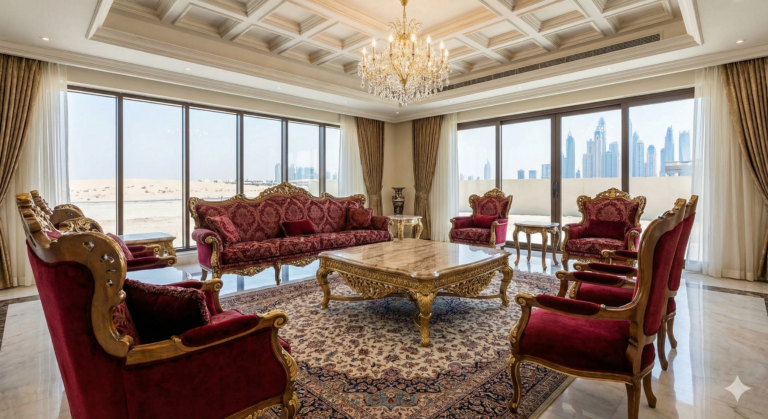
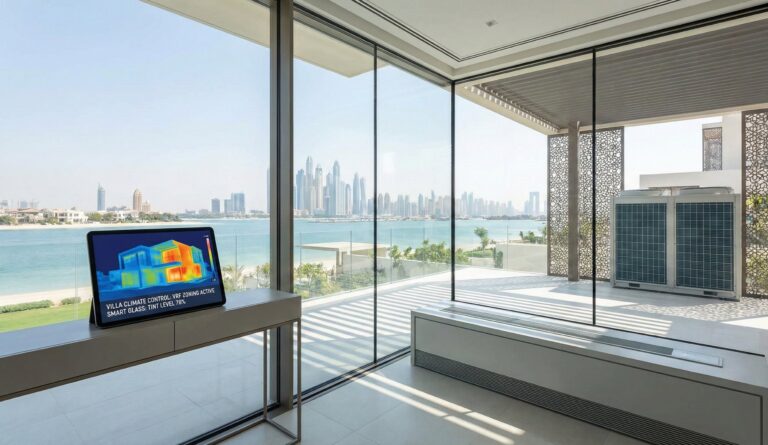
The 29-day shipping delay that stranded a container of Milanese sofas off the coast of Jebel Ali in 2021 marked a turning point for interior designers across the Emirates. What began as frustration evolved into opportunity. Today, a different conversation unfolds in Dubai’s design studios—one where local manufacturing addresses problems that imported furniture never could.
The Physics of Place
European furniture manufacturers design for European homes. A standard Italian sectional measures 240cm in length, proportioned for Milanese apartments with 280cm ceiling heights. Place that same piece in a Dubai villa with 450cm ceilings and 8-meter Majlis walls, and the mismatch becomes immediate. The furniture doesn’t disappear—it shrinks, leaving vast expanses of wall that expose rather than complete the space.
Local manufacturers solve this through dimension, not decoration. OPPOLIA Home produces modular cabinetry systems that extend to ceiling heights uncommon in European catalogs. Their production facility in Jebel Ali maintains tooling for panels up to 360cm—a specification that would require custom orders and premium pricing from Italian workshops. The result reads as cohesive design rather than assembled afterthought.
Climate presents the second challenge import catalogs cannot address. The 60% humidity differential between an air-conditioned interior and a summer afternoon in Dubai subjects furniture joints to expansion cycles European pieces never encounter. Veneer lifting, drawer warping, and finish crazing appear within months when construction methods assume stable humidity.
Westwood Interior manufactures using joinery techniques adapted for these conditions. Floating panel construction allows wood movement without stress fractures. Marine-grade adhesives resist the repeated wet-dry cycling that standard PVA bonds cannot withstand. These modifications remain invisible in the finished piece, yet determine whether a credenza survives its second August.
Speed as Infrastructure
Italian furniture operates on harvest cycles. Walnut cut in Umbria in autumn gets milled in winter, air-dried through spring, and fabricated the following summer. A sofa ordered in January arrives in July if production proceeds without delay. Shipping adds another 6-8 weeks. The timeline reflects craft, but it also reflects distance.
UAE-based manufacturers compress this interval not through shortcuts but through proximity. OPPOLIA Home maintains inventory of pre-finished panels in 47 standard colors. A kitchen order placed Monday can reach installation by the following week. Westwood Interior keeps common hardwoods in climate-controlled storage, eliminating the moisture content adjustments that delay European imports by weeks.
This speed enables design decisions European timelines prohibit. A developer can finalize villa interiors after structural completion rather than specifying finishes nine months in advance. Homeowners can adjust furniture dimensions after occupancy reveals how spaces actually function. The compressed timeline shifts furniture from fixed specification to responsive element.
Materials That Respond to Context
LushSpaces sources reclaimed teak from Sharjah dhow yards—timber that has already survived decades of humidity cycling in harsher conditions than any villa interior. The wood comes pre-weathered, its movement patterns established, its color deepened beyond what kiln-drying achieves. Furniture built from these planks carries physical memory of the climate it will inhabit.
The Bowery Company imports FSC-certified oak from Scandinavia but manufactures in Dubai, applying finishes formulated for Gulf conditions. Their water-based polyurethanes contain UV inhibitors at concentrations triple what European specifications require, compensating for the intensity of light through floor-to-ceiling windows common in contemporary villas. The wood ages without the yellowing that mars northern finishes in southern latitudes.
These adaptations exist outside aesthetic preference. Bamboo—which LushSpaces uses for cabinetry substrates—achieves dimensional stability in high humidity that particle board cannot match. Its rapid growth cycle (harvest maturity in 3-5 years versus 40-60 for hardwoods) aligns with sustainability metrics, but manufacturers select it primarily because it performs. Environmental benefit follows from material logic rather than preceding it.
A Vernacular Under Construction
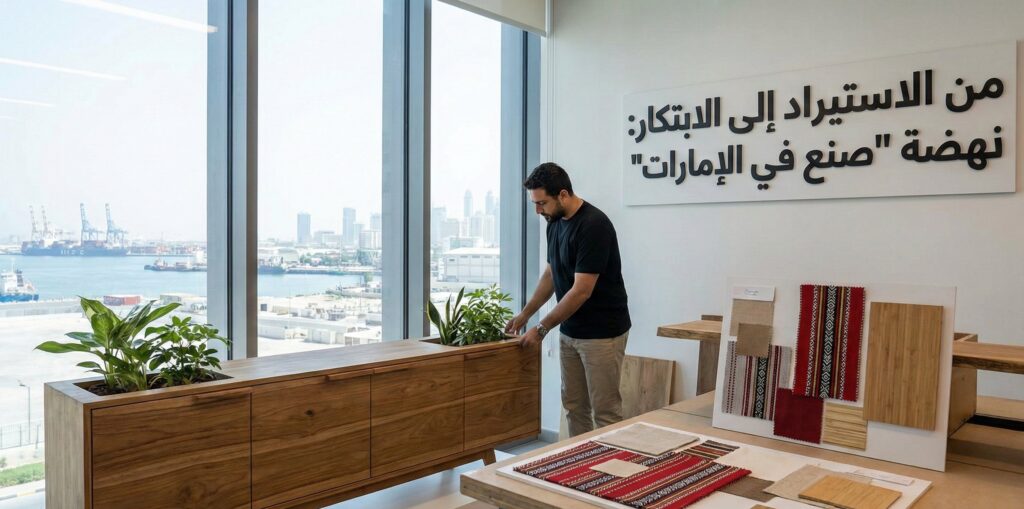
Local design studios have begun developing formal languages that respond to regional conditions rather than importing European solutions wholesale. Biophilic elements in UAE furniture differ from their Western precedents not in philosophy but in execution. Built-in planters within credenzas and consoles accommodate the Ficus and Dracaena varieties that thrive in air-conditioned environments, with irrigation systems that account for the low ambient humidity these conditions create.
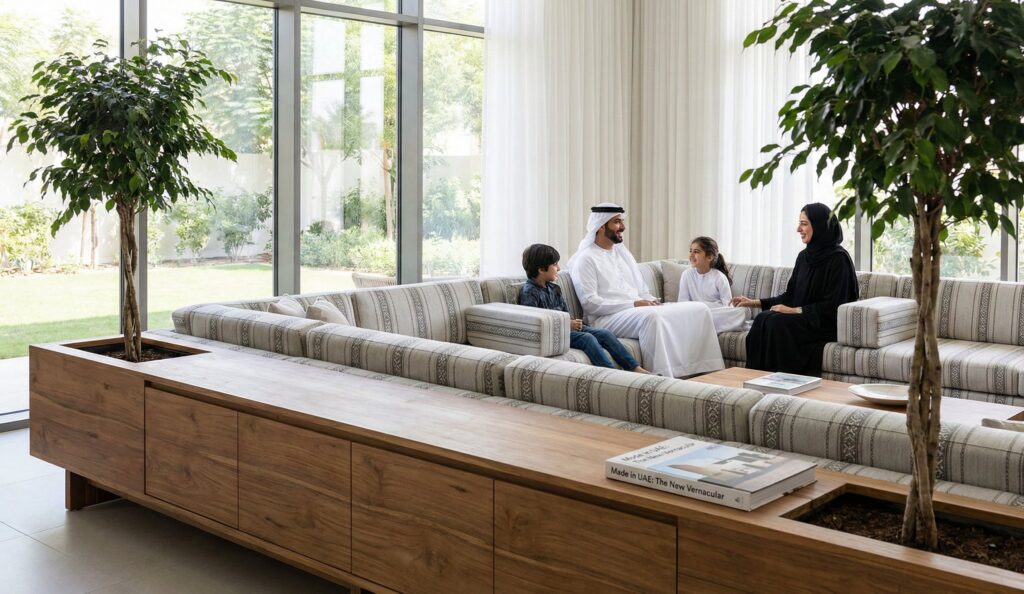
The integration of Sadu patterns—traditional Bedouin weaving motifs—into contemporary upholstery represents cultural reference filtered through material constraint. These geometric patterns originated as wool weaving accommodated the limited dye palette available to nomadic communities. Contemporary textile mills reproduce these patterns in synthetic fibers engineered for the abrasion resistance and color-fastness that natural fibers cannot provide in high-use applications. The visual continuity masks complete material transformation.
This emerging aesthetic serves function before symbol. High ceilings demand vertical elements that European furniture catalogs rarely provide. Large gathering spaces require modular seating that reconfigures without appearing institutional. Intense sunlight necessitates finishes that resist fading. Local manufacturers address these requirements through design responses that gradually accumulate into recognizable style.
Economics of Proximity
The price differential between local and imported furniture has narrowed as shipping costs have risen. A mid-range Italian sofa that cost AED 18,000 in 2019 now approaches AED 25,000 after freight surcharges and extended transit times increase insurance premiums. OPPOLIA Home produces comparable pieces at AED 19,000-22,000, a margin that reflects reduced logistics rather than reduced quality.
More significant than price is the shift in risk. Import furniture requires full payment months before delivery, with limited recourse for delays or quality issues discovered upon arrival. Local manufacturers offer installation timelines measured in weeks, with quality verification before final payment. For developers managing occupancy deadlines, this predictability carries value independent of cost savings.
The turnkey model that Westwood Interior provides—complete villa furnishing from architectural millwork through loose furniture—consolidates procurement that import catalogs fragment across multiple vendors and shipping schedules. Single-source accountability reduces coordination overhead while enabling aesthetic coherence difficult to achieve when assembling pieces from disparate manufacturers.
Infrastructure Beneath the Surface
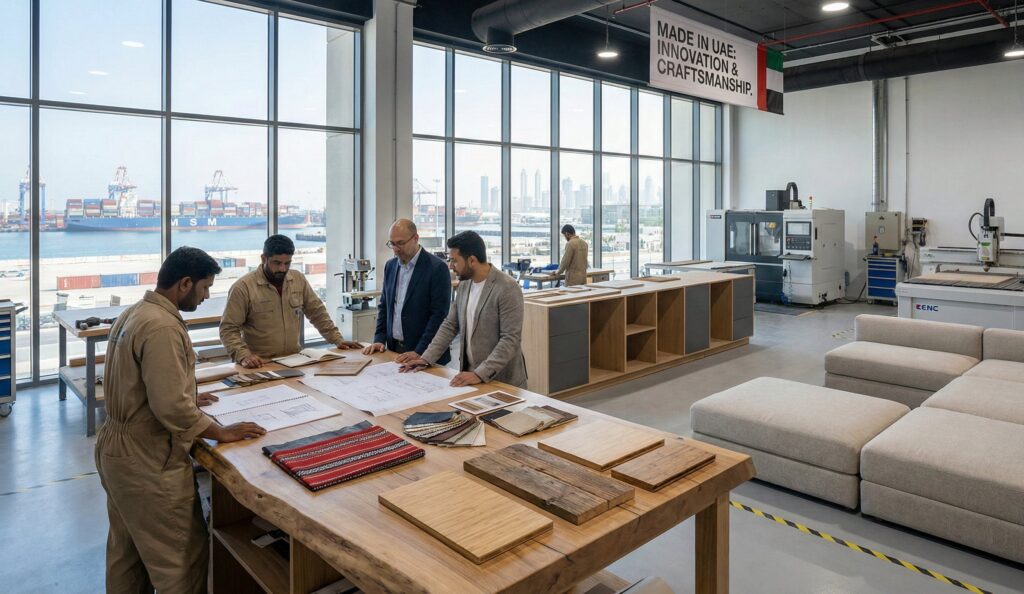
The growth of UAE furniture manufacturing reflects broader industrial development seldom visible in design publications. The establishment of CNC machining facilities capable of processing full sheet goods, spray booth installations that meet European emissions standards, and upholstery workshops with pattern-making capabilities represent capital investments that exceed what smaller European ateliers can justify.
OPPOLIA Home operates equipment identical to what Milanese manufacturers use—the same Biesse panel saws, the same Homag edge-banders. The machinery costs the same regardless of location. What differs is the operational context: lower real estate costs, proximity to shipping infrastructure, and access to the same imported hardware (Blum hinges, Hafele drawer systems) that European manufacturers specify.
This industrial parity challenges assumptions about where quality originates. A drawer box assembled in Dubai using dovetail joinery, European hardware, and locally sourced plywood performs identically to one produced in Brianza. The nameplate differs; the engineering does not.
The Market Test
Adoption provides clearer assessment than marketing claims. Interior designers who previously specified exclusively European furniture now incorporate local manufacturers for 40-60% of project volume, reserving imports for signature pieces where provenance matters to clients. This mixed approach suggests local production has achieved functional equivalence while retaining cost and timeline advantages.
The test arrives not in showrooms but in occupied homes. Furniture that survives five years of Gulf climate without finish degradation, joint failure, or dimensional instability validates manufacturing methods more conclusively than any certification. OPPOLIA Home’s warranty claims run below 2%—a rate comparable to established European brands and well below the 8-12% typical of budget imports.
Client retention offers another metric. Developers who used Westwood Interior for initial villa fit-outs return for subsequent projects, a pattern that indicates satisfaction beyond the constraints of single transactions. Repeat business in luxury markets reflects performance, not price.
What Local Manufacturing Enables
The presence of fabrication capacity within the Emirates changes what designers can propose. Custom sizing becomes standard rather than premium option. Material experimentation—testing finishes, trying alternate joinery—occurs within days rather than requiring sample shipments from Europe. Design iteration compresses from months to weeks.
This responsiveness particularly benefits adaptive reuse projects where existing architecture imposes dimensional constraints. Fitting contemporary furniture into heritage buildings with non-standard room proportions requires customization that import catalogs cannot economically provide. Local manufacturers make these projects viable.
The ability to visit production facilities, verify quality during fabrication, and adjust specifications before completion provides control that international supply chains eliminate. For clients accustomed to this oversight in construction, extending it to furniture fabrication feels natural rather than excessive.
Beyond Substitution
Local furniture manufacturing has progressed past the stage where it merely replaces imports. The industry now addresses needs that imported furniture was never designed to meet—the dimensional requirements of regional architecture, the material demands of Gulf climate, the timeline expectations of fast-paced development.
OPPOLIA Home, Westwood Interior, LushSpaces, and The Bowery Company represent industrial capability, not patriotic compromise. They compete on delivery speed, customization flexibility, and environmental adaptation—advantages that geography provides and that no amount of European heritage can overcome.
The question facing buyers has shifted from whether local manufacturers can match import quality to whether imported furniture can match local manufacturers’ responsiveness. In markets where construction timelines compress and client expectations evolve during projects rather than before them, the ability to adapt matters more than the prestige of distant workshops.
The “Made in UAE” label now signals not origin but capability—the capacity to produce furniture that fits the spaces, survives the climate, and arrives within the timelines that Gulf development requires. Import furniture will always have its place for clients who value specific provenance. But for an increasing share of projects, the question is no longer whether to buy local, but why buy anything else.