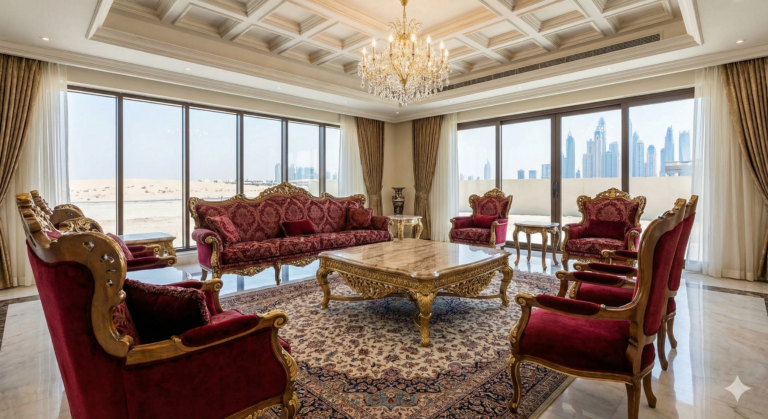
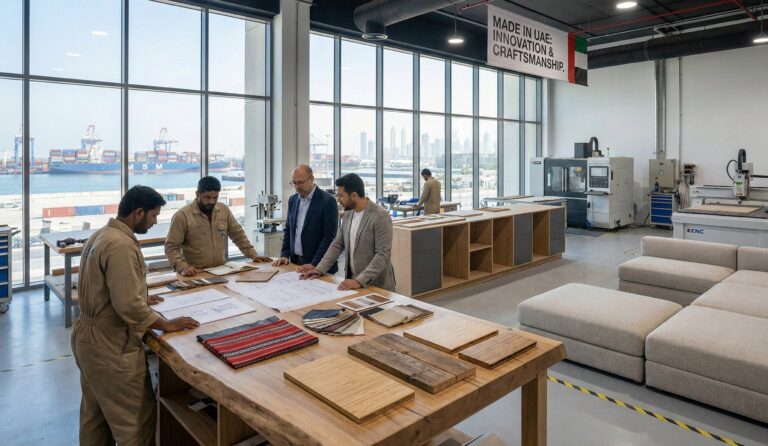
The UAE villa presents a paradox. Its owners commission soaring double-height majlis spaces and floor-to-ceiling windows that capture views of the Arabian Gulf, yet these same architectural ambitions create thermal nightmares. A 12,000-square-foot residence in Dubai Marina can consume 150,000 kWh annually—roughly equivalent to powering fifteen average American homes—with cooling accounting for 65% of that total.
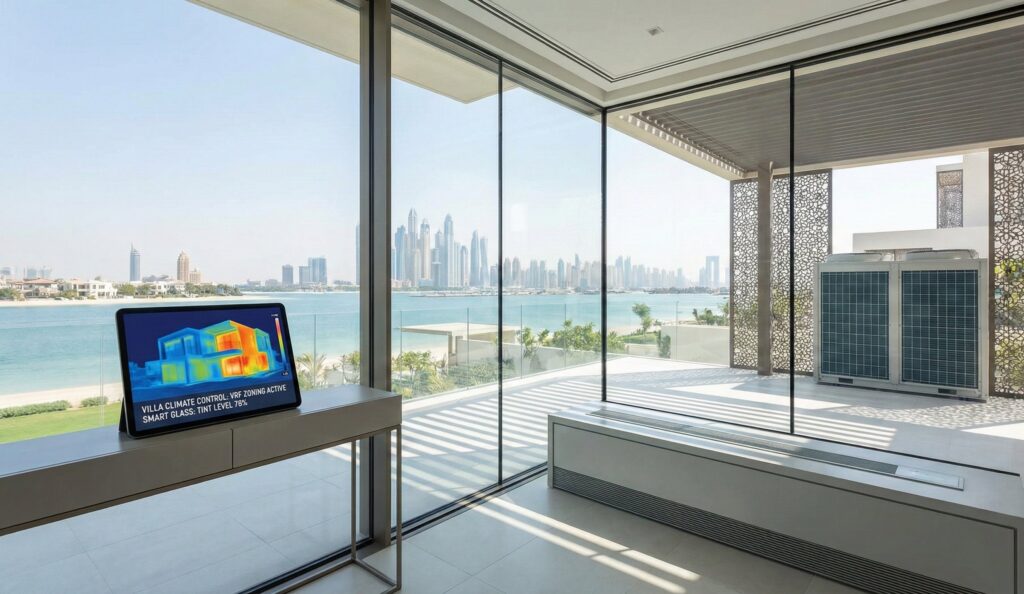
This is not a problem that resolves through brute force. Installing a larger chiller or adding more split units addresses symptoms while ignoring the underlying engineering failure: conventional residential cooling systems were never designed for structures of this scale operating in ambient temperatures that regularly exceed 48°C.
The Failure Mode of Standard Systems
Walk through most UAE villas during peak summer, and you’ll encounter the telltale signs of inadequate climate control. The entrance foyer sits at a comfortable 22°C while the mezzanine library hovers at 28°C. Bedrooms facing east are frigid at dawn but unbearable by afternoon. The cinema room maintains stable temperature only because the doors stay closed, creating an inadvertent refrigerated bunker.
Traditional ducted split systems operate on binary logic. They blast cold air until a thermostat signals satisfaction, then shut down completely. This on-off cycling creates temperature swings of 3-4°C within a single space and fails to account for the radically different thermal loads across a large residence. The northwestern guest suite with triple-glazed windows requires a fraction of the cooling demanded by the southeastern master bedroom with its decorative mashrabiya screens that block air circulation while admitting heat.
District cooling, while efficient at urban scale, imposes building-level control that makes zone-specific management impossible. A family hosting an evening gathering in the ground-floor reception areas cannot reduce cooling to bedrooms that remain unoccupied without affecting the entire connected system.
Variable Refrigerant Flow: Precision Engineering
VRF technology replaces the binary switch with a graduated response mechanism. A single outdoor unit connects to multiple indoor units through refrigerant piping, with an inverter-driven compressor that adjusts output in 1% increments. When the majlis requires maximum cooling while bedrooms sit in standby mode, the system delivers exactly the refrigerant volume needed for that specific load distribution.
The efficiency gains are measurable. A 2023 installation comparison in Palm Jumeirah documented a 4,800-square-meter villa consuming 41% less energy after replacing conventional splits with a Daikin VRV system. The retrofit cost AED 890,000 but generated monthly savings of AED 14,200 during summer months—a 51-month payback period that improved as DEWA rates increased.
VRF systems excel in the UAE’s specific climate challenges. Leading units from Daikin, Toshiba, and Midea operate reliably at outdoor temperatures up to 54°C, a threshold conventional compressors cannot sustain without frequent thermal shutdown. The technology permits heat recovery, allowing simultaneous cooling of sun-exposed spaces while redirecting waste heat to maintain comfortable water temperature in pools or spa facilities.
Zoning granularity extends beyond room-level control. A properly commissioned VRF installation in a seven-bedroom Emirates Hills residence uses 23 indoor units across three refrigerant circuits, permitting scenarios where the gym operates in ventilation-only mode, the kitchen receives spot cooling during meal preparation, and the master suite maintains sleeping temperature while guest bedrooms enter energy-saving standby.
The Glass Problem
The UAE’s architectural preference for expansive glazing conflicts directly with thermal management. A standard 6mm clear glass panel transmits 86% of solar radiation. In a west-facing room with 40 square meters of windows, this translates to roughly 28,000 watts of heat gain during late afternoon—equivalent to running 28 space heaters simultaneously.
Static solutions like reflective films or tinted glass reduce heat gain but permanently compromise natural light and views, defeating the purpose of the windows. Smart glass technologies provide dynamic response.
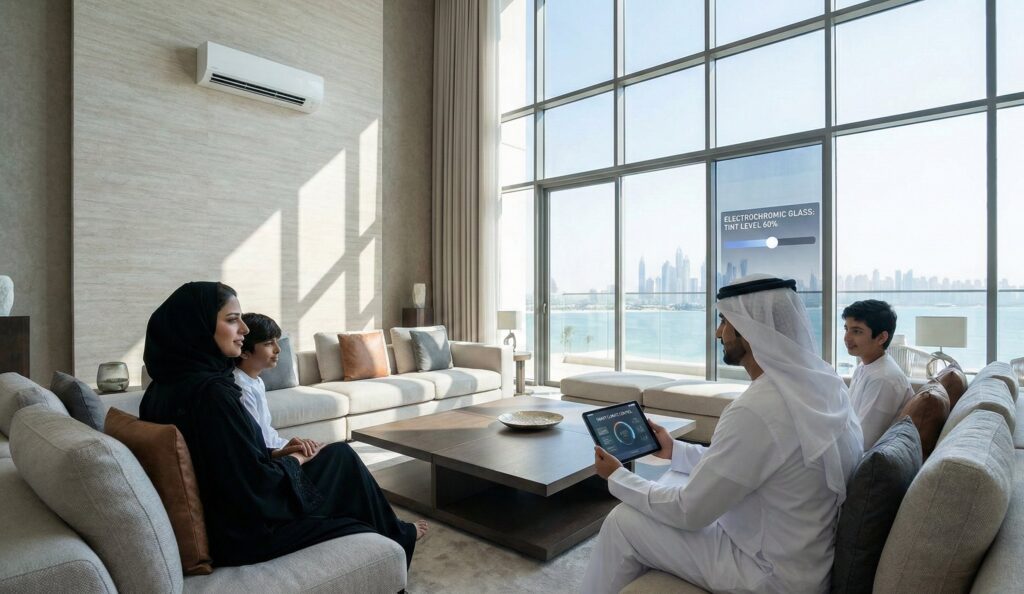
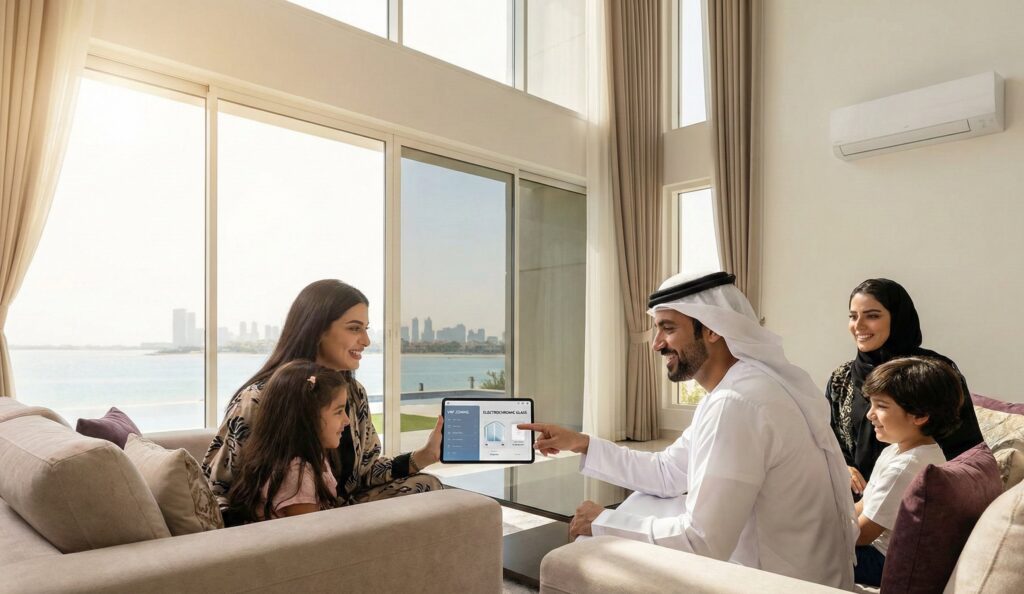
Electrochromic glass changes its tint electrically. At maximum opacity, it blocks up to 78% of solar heat while maintaining view transparency, unlike traditional blinds or curtains. The transition occurs gradually over 3-8 minutes, avoiding the jarring shift of binary systems. A typical installation uses roof-mounted light sensors to trigger tinting when solar radiation exceeds 600 W/m², with manual override through the home automation system.
Current UAE suppliers including Smart Glass Masters and Glass Labs report installations averaging AED 3,200 per square meter for electrochromic panels—roughly eight times the cost of conventional low-E glass. The thermal performance justifies this premium in specific applications. A 2024 monitoring study of a Jumeirah villa with 85 square meters of south-facing electrochromic glass documented 34% reduction in afternoon cooling load compared to an identical north-facing elevation using standard glazing.
PDLC glass offers different functionality. Its polymer layer scatters light when unpowered, creating instant privacy, but provides minimal thermal benefit. The technology suits bathrooms and interior partitions rather than heat-exposed facades.
Intelligent Environmental Management
The contemporary UAE villa functions as a sealed environment six months annually. Fresh air intake during summer introduces moisture and particulates that degrade indoor conditions, while sandstorms impose additional challenges that manual management cannot address effectively.
An integrated approach connects weather monitoring with mechanical systems. When local meteorological data indicates suspended particulate levels exceeding 150 µg/m³, the system closes outdoor air dampers and shifts to recirculation mode. Simultaneously, the HVAC adjusts to slight positive pressure—typically 5-8 Pascals above exterior pressure—that prevents dust infiltration through inevitable gaps in the building envelope.
This requires coordination between previously independent systems. Air quality sensors measure CO₂ concentration, volatile organic compounds, and particulate matter. When indoor CO₂ rises above 1000 ppm despite closed dampers, the system must choose between air quality and dust exclusion—a decision best made through programmed logic rather than occupant intervention.
Temperature management extends beyond air conditioning. A villa in Arabian Ranches implemented hydronic radiant cooling in its 280-square-meter ground floor, circulating 16°C water through pipes embedded in the marble floors. The system operates silently, eliminates drafts, and reduces cooling energy by 22% compared to forced air in that zone. The technology requires careful engineering to prevent condensation in humid conditions, necessitating continuous monitoring of dew point temperature.
Building Envelope Performance
Advanced mechanical systems cannot overcome fundamental failures in thermal insulation. The UAE building code mandates wall R-values of only R-13—adequate for moderate climates but insufficient for ambient temperatures approaching 50°C with intense solar radiation. Upgraded insulation to R-30 in exterior walls and R-49 in roof assemblies costs roughly AED 185 per square meter but reduces cooling loads by 25-30%.
Thermal bridging through concrete columns and floor slabs bypasses wall insulation. Infrared thermography of a newly constructed Emirates Hills villa revealed surface temperatures of 38°C on interior columns while adjacent insulated walls maintained 24°C. Addressing these bridges requires external insulation systems or spray foam application during construction—retrofitting proves difficult and expensive.
Air sealing matters more than most builders acknowledge. Blower door testing of ten luxury villas in Dubai revealed average air leakage rates of 12 air changes per hour at 50 Pascals pressure—triple the rate of well-sealed construction. Each unnecessary air change requires approximately 0.4 kWh to cool and dehumidify, translating to 15,000 kWh annually for a typical villa. Systematic sealing of penetrations, joints, and service entries typically costs AED 45,000-65,000 but recovers investment through reduced cooling demand within three years.
The Economic Reality
High-performance climate control requires significant capital investment. A complete thermal upgrade for a 6,000-square-meter villa—including VRF installation, electrochromic glass for critical exposures, enhanced insulation, and integrated automation—approaches AED 2.8 million beyond standard construction costs.
This expenditure delivers immediate quality-of-life improvements and measurable operating savings. The same property consuming 180,000 kWh annually with conventional systems typically reduces to 95,000-105,000 kWh with comprehensive optimization. At current DEWA rates with fuel surcharges, this generates annual savings of AED 47,000-58,000. More significantly, it produces stable indoor conditions without temperature fluctuations, humidity problems, or dust infiltration.
The UAE’s subsidy reform and increasing energy costs improve the financial case for efficiency investment. DEWA residential rates increased 34% between 2015 and 2024, with further adjustments expected as the nation transitions toward cost-reflective pricing. Properties engineered for thermal performance gain value as operating costs become material considerations in real estate transactions.
The technology exists. The suppliers operate locally. The remaining barrier is recognizing that luxury in this climate is not measured by imported marble or crystal chandeliers, but by the sophisticated engineering that makes a glass-walled sanctuary habitable when the exterior temperature exceeds human body temperature for months on end.